The Grand Return of Horn Loudspeakers: Luxury Audio Performance in NYC
The Art of the Audible:
Why Horn Loudspeakers Define the New Era of NYC Luxury Audio
For the discerning individual, luxury is rarely about the price tag; it is about the pursuit of the absolute. In the world of high-fidelity audio, that pursuit often leads to a single, revered name that bridges the gap between the golden age of cinema and modern engineering: GIP Laboratory. For those seeking the most authentic musical experience available, finding GIP speakers in NYC is not just a shopping trip—it is a pilgrimage to the soul of sound.
At In Living Stereo, located in the historic NoHo neighborhood of Manhattan, we specialize in the “un-commodity.” Our curated selection is designed for the client who demands more than just a premium brand; they demand a visceral, emotional connection to their music. As the premier destination for GIP speakers in the region, we invite you to discover why these handcrafted Japanese masterpieces are considered by many to be the greatest loudspeakers currently in production.

The Physics of Finesse: What Exactly is a Horn?
To understand why a horn is the preferred “voice” of a luxury audio system, you have to look past the striking, often sculptural aesthetics. At its core, a horn is an acoustic transformer. While a traditional speaker driver struggles to move the air in your room—much like a person trying to fan a flame with a flat piece of paper—a horn matches the impedance of the driver to the air in the room.
The result? Efficiency that borders on the supernatural.
Because the horn shape focuses and amplifies the sound naturally, the driver itself barely has to move to create massive, room-filling volume. This “low excursion” is the secret to the low distortion and “speed” that horn devotees crave. When you listen to horn loudspeakers, you aren’t just hearing a recording; you are hearing the “breath” of the woodwinds and the “bite” of the brass with a realism that conventional speakers simply cannot replicate.
The NYC Listening Room: A Unique Challenge
Most modern speakers use permanent magnets (typically neodymium or ferrite) to move the voice coil. While efficient, permanent magnets are static. GIP speakers utilize field-coil technology, which replaces the permanent magnet with a powerful electromagnet powered by a dedicated external power supply.
The result is a level of “speed” and “grip” over the driver that is startling. When you audition a pair of GIPs at our NYC showroom, the first thing you notice is the lack of “speaker sound.” There is no boxiness, no lag, and no compression. The music simply exists in the room, possessing a physical presence and a sense of scale that makes traditional high-end speakers sound thin by comparison.
Handcrafted Heritage: The Brands Defining the Sound
At In Living Stereo, we don’t just sell equipment; we curate experiences. Our selection of horn loudspeakers reflects a commitment to craftsmanship that mirrors the bespoke tailoring of Savile Row or the precision of a Swiss timepiece.
G.I.P. Laboratory: The Western Electric Legacy
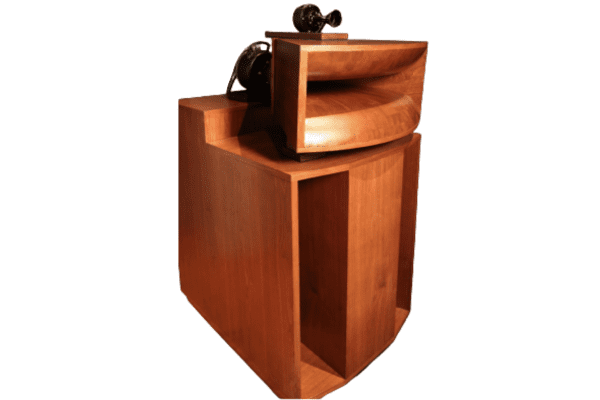
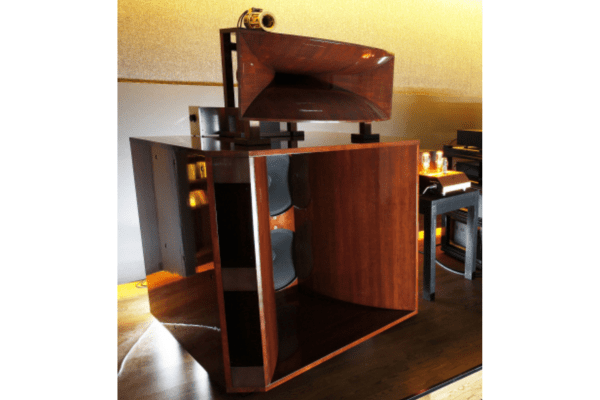
For the purist, there is G.I.P. Laboratory. These Japanese-made masterpieces are painstakingly built to replicate the legendary Western Electric theater systems of the 1930s. Using field-coil technology and intricate horn geometries, G.I.P. creates a sound that is hauntingly alive. To own a pair in NYC is to own a piece of audio history, refined for the modern age.
DeVore Fidelity: Brooklyn’s Own
While not a “pure” horn in the traditional sense, John DeVore’s Orangutan series utilizes wide-baffle designs and high-efficiency drivers that capture the spirit and “effortlessness” of the horn philosophy. Handcrafted right here in Brooklyn, these speakers are designed specifically to pair with the low-powered tube gear that makes music feel organic and soulful.
Why “Luxury” Audio is an Investment in Emotion
The word “luxury” is often overused, but in the context of high-end audio, it refers to the removal of barriers between you and the artist. When you invest in a system centered around horn loudspeakers, you are investing in the ability to be transported.
Imagine sitting in your living room on a rainy Tuesday night. You drop the needle on a pristine 180g pressing of Kind of Blue. With a traditional speaker, you hear a great record. With a horn-loaded system from In Living Stereo, you are in the room at Columbia 30th Street Studio in 1959. You can hear the mechanical click of Miles Davis’s trumpet valves; you can feel the physical vibration of the upright bass.
This level of performance requires more than just a credit card—it requires a consultation. The synergy between your speakers, your amplifier, and your room’s acoustics is a delicate dance. According to the Audio Engineering Society, the interaction between a loudspeaker’s directivity and room boundaries is one of the most critical factors in perceived sound quality. Our experts in NoHo specialize in “system matching,” ensuring that your investment delivers on its promise of sonic perfection.
Breaking the Myths: “Honk” vs. High Fidelity
If you mention “horns” to an old-school audiophile, they might recall the “shouty” or “nasal” sound of poorly designed PA systems from decades ago. We call this the “honk.”
However, modern engineering has completely eradicated these issues. Today’s luxury horn loudspeakers use complex mathematical curves—such as Tractrix or Le Cléac’h geometries—to ensure a smooth, linear frequency response. The result is a sound that is as sweet and refined as any electrostatic or ribbon speaker, but with a “kick” and dynamic range that those designs can only dream of.
Conclusion: Your Invitation to Listen
In a world of disposable technology and compressed digital files, there is something profoundly rebellious about a high-efficiency horn system. It is a commitment to slow listening, to quality over quantity, and to the belief that music deserves to be experienced in its full, unbridled glory.
Whether you are a lifelong collector or a newcomer to the world of high-fidelity, we invite you to experience the difference for yourself. New York City is a city of sound—make sure the sound in your home is the one you actually want to hear.